As I’ve been pondering data, business processes, and all the glue that holds all the things together, it occurred to me that spreadsheets are the pathogenic bacteria of the business world. (And email is the carrier?) Analogous to bacteria, having an imbalance is what can cause things to go awry. You don’t want to eliminate all spreadsheets (just like killing all bacteria would be a very bad idea) but instead replace the worse ones with a more systemic approach.
Continuing the analogy into the forest, and I’m certainly not the first to view systems like these through an ecological lens. The stately AS400s are your giant redwoods. Oracle and SAP’s JD Edwards? Giant Sequoias. ServiceNow might be a maple. Salesforce? A Banyan Tree.
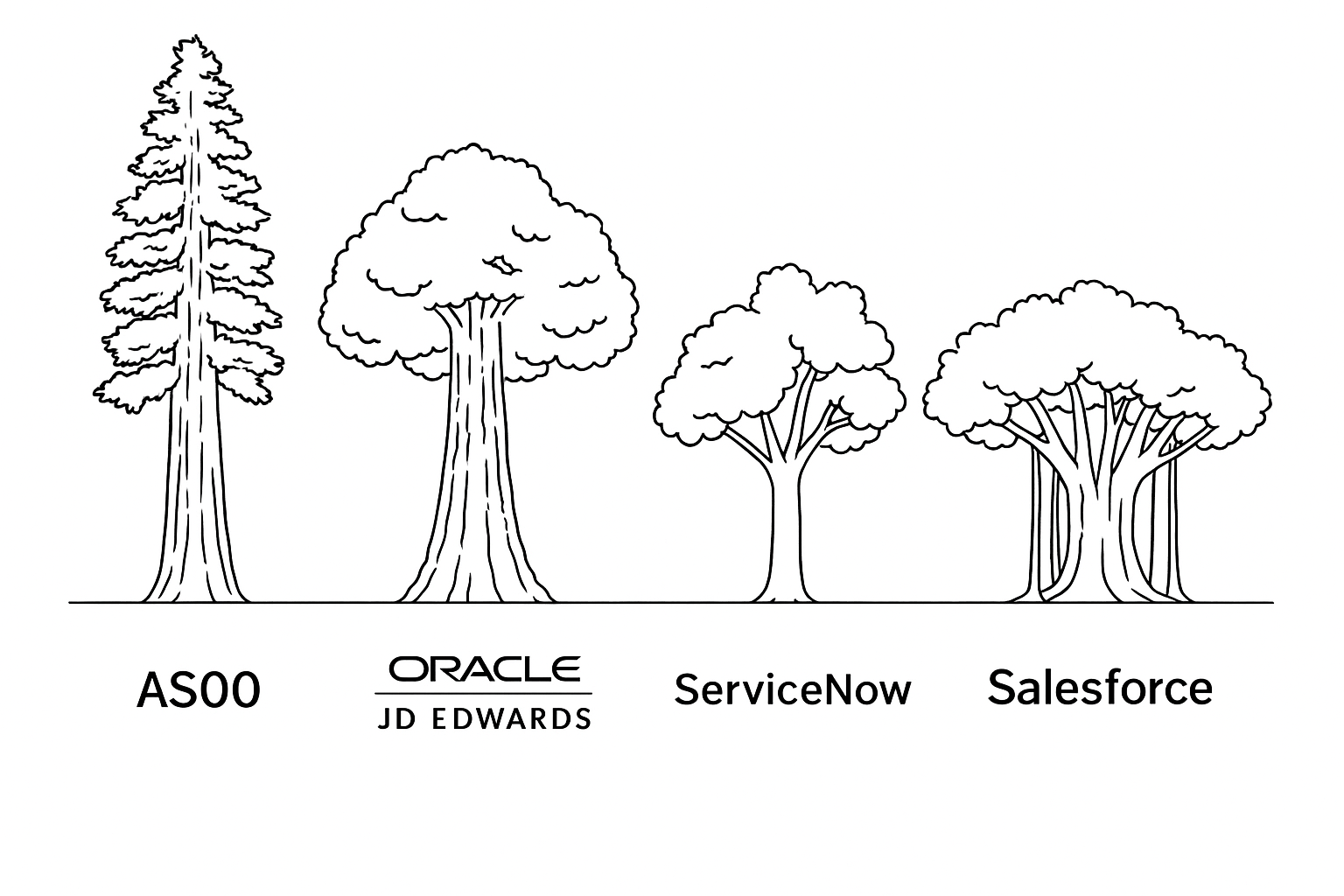
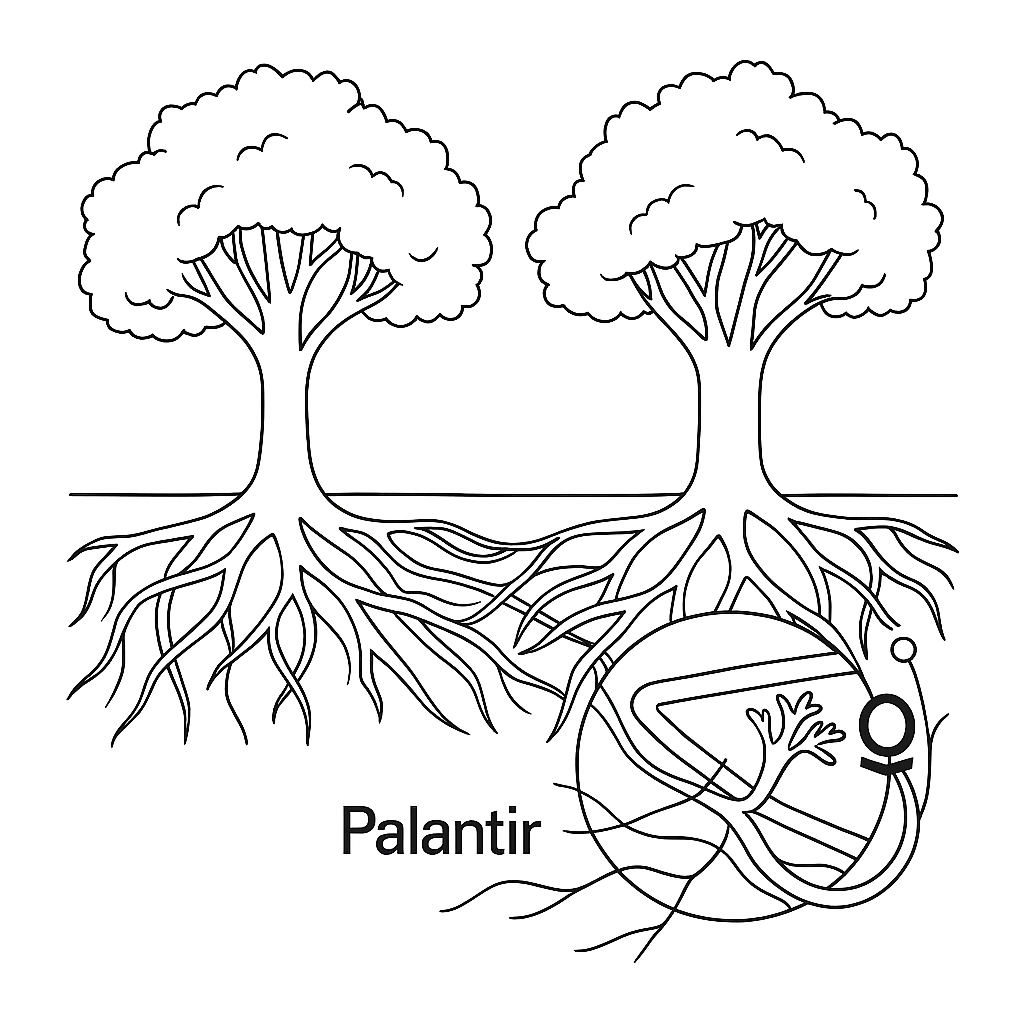
Connecting the roots of these trees is the mycorrhizal network (the analogy gets a bit rough but there are some examples of cross species connections, I digress)
Specifically with arbuscular mycorrhizal fungi, their thread-like structures grow into root cells and form a shared underground pipeline. Nutrients flow in, sugars flow out, and these connections often span across multiple plants.
All that to say, I visualize Palantir as this mycorrhizal fungal network.
I see three major themes that limit agility in business. The first, and foremost, is the actual business process itself. Often instead of trying to improve the process, it is instead just ‘automated’. But automating a flawed process can just mean doing dumb things faster. You need to find the root cause, go to gemba, get to the heart of the matter.
Palantir (as a company culture) with its FDE really shines in this aspect, they don’t just expect great systems architecture and software engineering, they have nerd savants that can talk to the business at every level and get to the real context of the problem. (They study improv and theatre, how to interview users.. ) https://nabeelqu.co/reflections-on-palantir
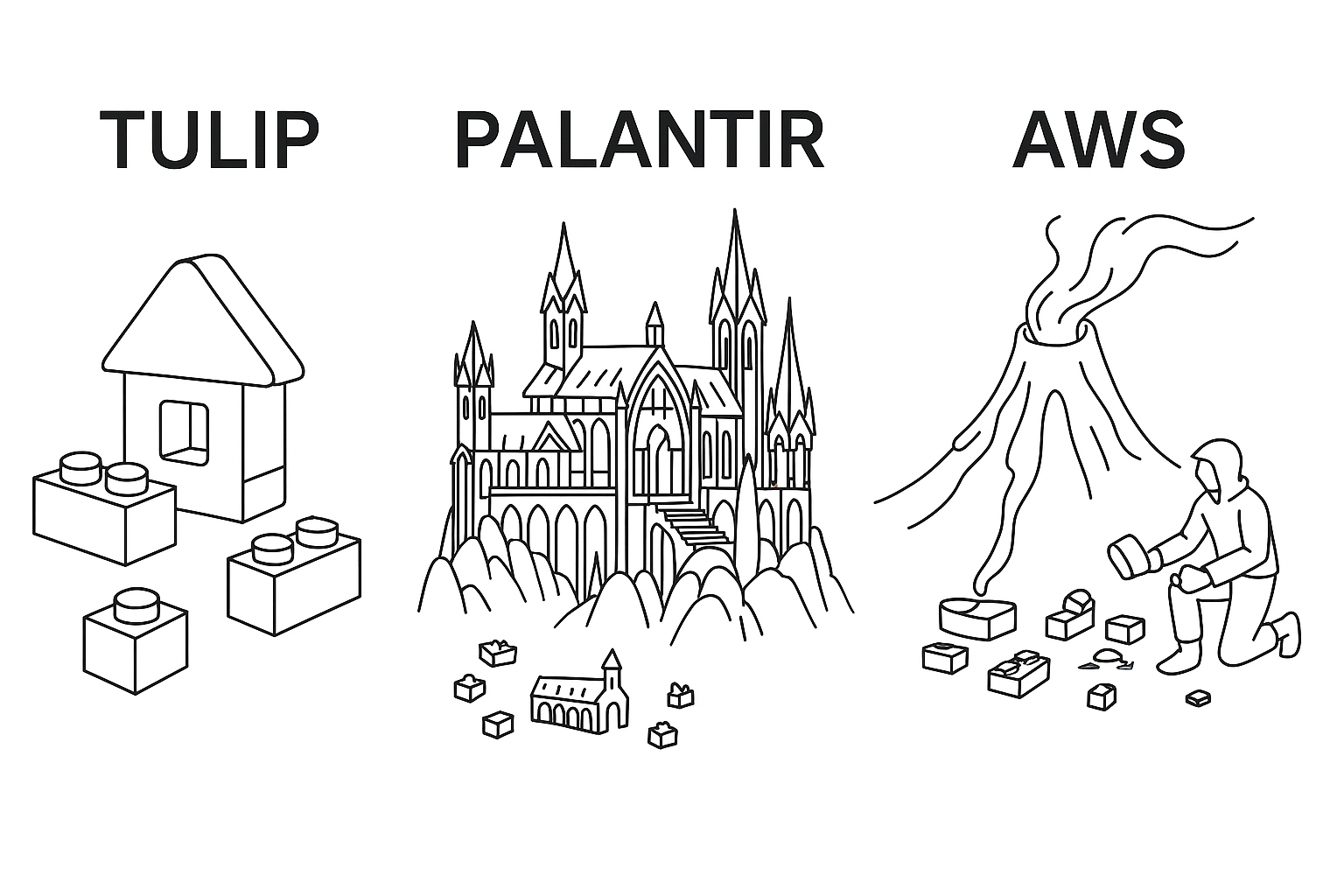
The second limiting theme is disconnected/siloed systems. First off, I can’t really say if Palantir is the best at this. But, I actually don’t know of anything that really compares (so best by default?) By bringing everything into this centralized ontology it becomes a forcing function, it becomes a place where all data must reside and can therefore interconnect. For example, using things like Palantir’s pipeline builder, under revision control, with approvals, and data integrity checks is way more effective than your one hundred and one janky python / glue scripts what have you. (I often relate that building with Tulip is like building with Lego\Duplos, building with Palantir is like building Rivendell with Nanoblocks, and building with AWS is like forging your own Legos inside Mount Doom ) There are many more examples of field tested tools that Palantir is adding to constantly. Their whole ethos is solving a customer problem and then productionalizing that solution for their customer base.
As a happy byproduct of this ontology, customers of Palantir/Founder can do *Actual AI*
What do I mean by actual AI? It’s not generating AI slop pictures to use on SharePoint. Since the Ontology is Actually how your business is running, and contains the context, connections, and interrelations, it is the perfect environment to run ML \ Vision \ Workflows and yes even LLM’s. (And any and all the LLM’s, they are just plugins into the ontology. And agents, of course. And whatever is next)
The third limiting theme is the idea that compiling data and making dashboards is good enough. Data in and of itself is not very useful. Dashboards are a bit more useful, data discovery tools are more so (I bleed green, white, and grey… using Qlik as just a dashboarding platform is a bit of a travesty) Being able to explore data in a non-linear fashion was revolutionary!
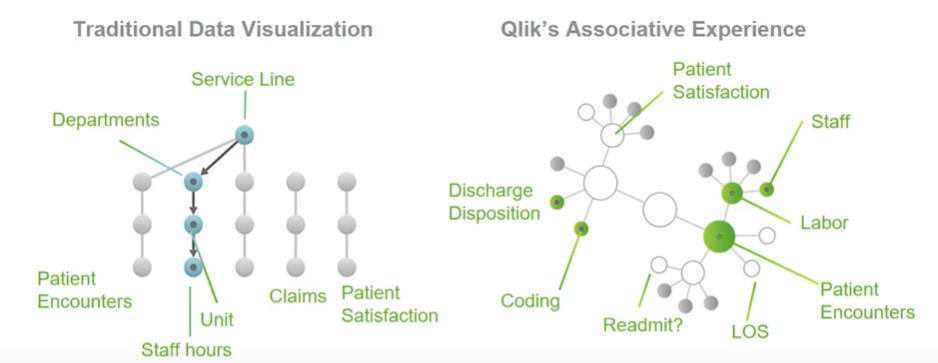
But still, when you finally find insight (or better yet, if the insight finds you!) the next natural desired state is to take that actionable data, and action it! And here we circle back to the mycorrhizal fungal network. With your business as code / with the ontology acting as that fungal transport between all your trees and plants and ferns the most important thing the ontology can do is action your data. Writing back to the ontology and calling API’s is what allows a user to not just look at a dashboard and then swivel chair to their ERP / WMS / what have you system to do something about it, but to action something from where they already are.
 Michael Ellerbeck
[…] we go with the analogy that spreadsheets are the bacteria of the business world. We would need Palantir to handle this necessary evil. And it doesFrom a least complex to most […]
[…] the Ontology being our mycorrhizal fungal network, naturally, we will need to interact with our data. There are almost innumerable ways to interact […]
[…] visualize Palantir as a mycorrhizal fungal network and I’m also a disciple of the ‘Just use Postgres‘ […]